
Calanda
History of Calanda
In the heart of Bajo Aragón, Calanda emerges as a living tableau of history and tradition. Imagine a town where the rhythmic echoes of drums and the fragrance of fruit orchards weave centuries of cultural heritage with the beauty of a landscape that invites you to lose yourself and connect with the soul of the land.
Legend has it that in 1127, a shepherd tending his flock used his drum to warn the townspeople of an impending Moorish raid, thus beginning a tradition that became the heartbeat of this region.
Calanda’s origins date back to pre-Roman times, with Celtiberian settlements giving rise to the name “Kolenda.” During Roman rule, the town flourished as a significant hub, benefiting from the advanced infrastructure and trade networks of the time.
Under Moorish rule, Calanda experienced significant advancements, particularly in irrigation and agriculture.
In 1169, King Alfonso II of Aragón reconquered Calanda, integrating it permanently into the Kingdom of Aragón. By the late 13th century, the Order of Calatrava had assumed control of the town, profoundly shaping its social and economic structure. In 1360, the first Carta Puebla, or Charter of Settlement, was granted, encouraging repopulation and fostering the town’s growth. Later, in 1628, a second Carta Puebla further consolidated Calanda’s political and religious unity, boosting its economic development and solidifying its importance in the region.
What is a Carta Puebla?
A Carta Puebla was a document issued by a feudal lord—in this case, the Order of Calatrava—to regulate the settlement of a territory. These charters outlined the rights and obligations of new inhabitants and often provided benefits such as tax exemptions or land allocations to attract settlers to depopulated or newly conquered areas.
In Calanda, the first Carta Puebla of 1360 facilitated its population and economic growth, while the second, issued in 1628, consolidated its political and religious unity, further promoting its development.
During the Carlist Wars of the 19th century, Calanda became the site of intense conflict, culminating in the destruction of its castle in 1838. Despite these challenges, the town preserved and revitalised its traditions, becoming a cultural benchmark in the region. This deep cultural heritage, combined with its profound connection to Easter, led UNESCO in 2014 to recognise the drumbeat ceremonies of Bajo Aragón, including those of Calanda, as part of the Intangible Cultural Heritage of Humanity.
The Eternal Drumbeat: Easter in Calanda
Calanda’s Easter celebrations are internationally renowned, particularly for the iconic “Rompida de la Hora” (Breaking of the Hour).
Each Good Friday at midday, hundreds of drums and bass drums burst into a synchronised crescendo, symbolising mourning for the death of Christ and creating an atmosphere of profound collective emotion.
This ancient tradition has its roots in legend. According to stories, in the spring of 1127, while Christians in Calanda observed Easter, a Moorish raid was imminent. A shepherd, upon spotting the danger from a nearby hill, used his tambourine to sound the alarm. The warning spread from shepherd to shepherd, creating a chain that allowed the townspeople to seek refuge and thwart the attack.
This event marked the beginning of a custom that evolved into the vibrant tradition we know today.
In the 20th century, Mosén Vicente Allanegui revived the celebrations, organising processions and giving the drumbeat profound symbolic meaning. The rituals he established continue to resonate in Calanda’s streets.
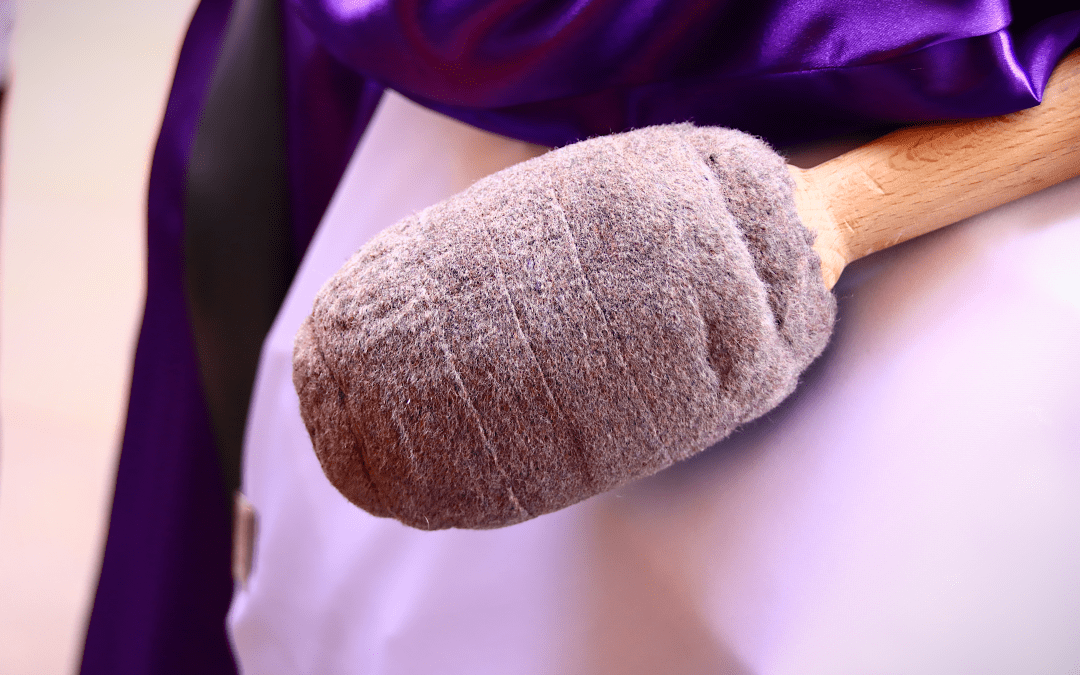
The craftsmanship involved in making the drums and bass drums of Calanda has been passed down through generations. Drums are crafted from steel, aluminium, or brass shells, with beechwood or aluminium rims, and copper snares wrapped in silk, producing their characteristic sound. The drumheads, typically made of polyester, allow precise tuning to suit the musician’s preference.
Meanwhile, bass drums are made from reinforced cardboard shells with beechwood supports. Their drumheads, often natural hides such as goatskin or calfskin, may also include synthetic alternatives. Hemp ropes ensure stable tuning, while wooden rims contribute to the high-quality acoustics.
These handcrafted instruments are essential to Calanda’s Easter celebrations. Recognised as a Fiesta of International Tourist Interest, Calanda’s Easter traditions form part of the Bajo Aragón Drum and Bass Drum Route, a network of towns dedicated to preserving and promoting this unique cultural heritage.
Architecture
Calanda is home to a wealth of historical and architectural landmarks that reflect its rich cultural heritage. Highlights include:
Parish Church of Nuestra Señora de la Esperanza
Originally built in the 13th century and expanded in 1462 by Pedro Vacca, this church was associated with the Order of Calatrava. The current neoclassical structure, with rococo influences, dates from the 18th century and features three naves, with the central one towering above the others.
Temple of El Pilar
Built in the 17th century, this temple is a prime example of Aragonese Baroque architecture, with an ornate facade and intricate details.
Convent of El Desierto
Founded in the 17th century and nestled between the Guadalope and Mezquín rivers, this convent’s impressive facade stands as a testament to religious architecture, despite its current state of ruin.
Calanda Castle
Dating back to the Muslim era, the castle was occupied by Alfonso II in 1169 and later passed to the Alagón family and the Order of Calatrava. Though destroyed during the Carlist Wars in 1838, its remains evoke its historical significance.
San Roque Arch
Constructed in the 18th century, this arch exemplifies traditional Aragonese architecture and has witnessed countless events over the centuries.
Calanda Icehouse
The Calanda Icehouse is an underground structure documented since the 18th century. These types of constructions flourished between the 16th and 18th centuries and stand as a testament to the ingenious methods of food preservation during that era.
Its main structure features a central dome measuring 5.3 metres in diameter and 7.3 metres in height, complemented by four tunnels added later, forming a cross shape in the floor plan.
After the 19th-century confiscations, the icehouse passed into private hands, serving as a wine cellar and mushroom farm. The Crespo family, its last owners, preserved the building and donated it to the local council for restoration.
Today, the Calanda Icehouse is part of the Ruta de las Bóvedas del Frío (Route of the Ice Vaults), one of the region’s standout tourist attractions.
Calanda Town Hall
This neo-Mudéjar building from the 20th century is a local landmark, featuring a striking red brick facade and ornamental details.
Casa Cascajares (Casa Allanegui)
Casa Cascajares, also known as Casa Allanegui, is an architectural gem that combines the grandeur of ashlar stone and brick with delicate Mudéjar elements, showcasing the splendour of 16th and 17th-century Calanda. Its elegant loggia, featuring eleven arches adorning the main and side facades, stands as a prominent example of Aragonese civil architecture from the period.
This historic building was the residence of the influential Cascajares family and the birthplace of Cardinal Antonio María Cascajares, a key figure in Spanish ecclesiastical history. Although the Arco de Mosén Vicente Allanegui, a symbol of Calanda’s Easter traditions, is no longer part of the property, its legacy remains alive in the street that bears his name, adding a layer of cultural and religious significance to this emblematic site.
Casa de Cultura Víctor Romero
The Casa de Cultura “Víctor Romero” is a landmark cultural space in the heart of Calanda, blending history and modernity. Originally established in 1750 as a Capuchin convent, the building has been transformed over the centuries to meet the community’s evolving needs.
Today, its interior houses a municipal library, an auditorium dedicated to the Luis Buñuel Cinema Club, and a repurposed chapel that serves as an exhibition hall showcasing ancient Iberian ceramics alongside traditional regional pieces.
This venue is not just a haven for culture but also a gathering place for local associations, enriching Calanda’s cultural life and reflecting the vibrant spirit of this Aragonese town.
Acueducto de Los Arcos
The Acueducto de Los Arcos, located one kilometre southeast of Calanda, is a remarkable feat of engineering that has withstood the test of time. Built with ashlar stone, it features five large semicircular arches and a top channel that continues to carry irrigation water.
While its exact origins remain uncertain, with some theories linking it to Roman or Islamic periods, the first documented reference dates to the 17th century. In his writings, cartographer Juan Bautista Labaña described it as a well-built structure serving the local farmland.
The aqueduct is not only a testament to the ingenuity of its builders but also a symbol of Calanda’s historical bond with its land and water, key pillars of its agricultural and cultural development.
El Puente Nuevo (New Bridge)
The Puente Nuevo, also known as the Bridge of Infante Don Antonio Pascual, is a significant 18th-century engineering achievement spanning the Guadalope River ravine, downstream from the Calanda Dam.
Part of an ambitious hydraulic project led by Infante Don Antonio Pascual, the viaduct-aqueduct was designed to enhance the region’s irrigation systems. Alongside other infrastructures like the Villanueva Dam and the Arcos de Lacarra (now submerged under the reservoir), the Puente Nuevo stands as a testament to Calanda’s historic dedication to optimising water management and sustaining its fertile lands.
Calanda’s charming streets, adorned with stone facades and flowered balconies, transport visitors to another time. The surrounding area is also rich with archaeological remains and historic sites that complement the town’s cultural appeal.
Famous Figures of Calanda
Calanda has produced remarkable individuals who have left an indelible mark on history and culture.
One such figure is Luis Buñuel, the acclaimed surrealist filmmaker and one of Calanda’s most celebrated sons. In his autobiography My Last Sigh, he wrote:
“I don’t know what causes this emotion, comparable to the feeling evoked by music. It must be the pulse of a secret rhythm that reaches us from outside, producing a physical shiver beyond reason.”
Buñuel’s connection to Calanda is evident in his work, where the sound of the drums became an evocative motif in films like Viridiana and The Exterminating Angel. The town honours his legacy with the Buñuel Centre of Calanda (CBC), a space dedicated to his life and creative universe.
Another notable figure is the Blessed Miguel Pellicer, famous for the miraculous restoration of his amputated leg, a story that cemented Calanda’s religious significance. In 1640, following a period of devout prayer to the Virgin of El Pilar, Pellicer’s leg was miraculously restored. This event was investigated by church authorities and officially recognised as a miracle in 1641.
Gastronomy
Calanda’s cuisine reflects its deep agricultural and pastoral roots. Imagine savouring a juicy Calanda peach under the shade of an almond tree, its sweetness and firm texture capturing the essence of the region’s sun-soaked orchards. Or picture a plate of Ternasco de Aragón (roast lamb), where every bite pays tribute to the farmers and shepherds who have nurtured these traditions.
Highlights of Calanda’s culinary heritage include:
- Calanda Peach: With a Protected Designation of Origin (PDO), this fruit is celebrated not only fresh but also in the traditional dessert melocotón con vino (peaches in wine). Each peach is carefully bagged on the tree during ripening, ensuring its superior quality.
- Bajo Aragón Olive Oil: Renowned for its intense flavour and fruity aroma, this oil is a staple in local cuisine.
- Ternasco de Aragón: This tender and succulent lamb is a hallmark of the region, enjoyed in both roasts and stews.
Calanda’s culinary richness is further enhanced by traditional recipes passed down through generations, showcasing the freshness of local produce and the region’s timeless cooking techniques.